
Michael Markowitz

Buying a new home is exciting, but if you find your next home before your current one sells, you may be left with an important question: How can you access the equity you've built in your current home to help cover a down payment, closing costs, or other expenses?
Two common options homeowners consider are bridge loans and home equity lines of credit (HELOCs). Both can help you buy before selling, but they work differently and may fit different situations. This guide explains the difference between a bridge loan and a HELOC, including costs, timing, impact on mortgage approval, and when each option may make sense.
What is a bridge loan?
A bridge loan is a short-term loan that helps you buy a new home before selling your current one. It allows you to borrow against the equity you've built in your existing home, giving you access to funds for a down payment, closing costs, or even the purchase of your next home.
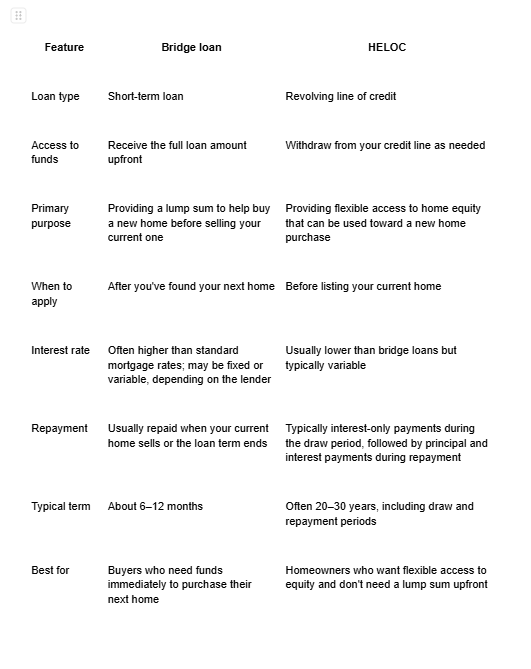
As the name suggests, a bridge loan "bridges" the financial gap between purchasing your next home and receiving the proceeds from selling your current one. Bridge loans are typically issued as a lump sum and repaid after your home sells. Most terms last six months to a year, although some lenders offer longer repayment periods.
What is a HELOC?
A home equity line of credit (HELOC) is a revolving line of credit that lets you borrow against the equity you've built in your home. It works much like a credit card: You're approved for a credit limit, but instead of receiving the full amount upfront, you can withdraw funds as needed and pay interest only on the amount you've borrowed.
HELOCs typically have two phases. During the draw period, which often lasts about 10 years, you can borrow, repay, and borrow again up to your credit limit. Depending on the lender, you may be required to make interest payments during this time. Once the repayment period begins, which may last about 20 years, you can no longer withdraw funds, and you'll repay the remaining balance plus interest. HELOCs usually have variable interest rates, meaning your monthly payment may rise or fall as interest rates change.
Bridge loan vs. HELOC: Key differences at a glance
Both bridge loans and HELOCs allow homeowners to access the equity in their current home, but they're designed for different situations. The right choice depends on your timeline, financial situation, and how you plan to use those funds.
Can you use a HELOC as a bridge loan?
Yes, a HELOC can sometimes serve a similar purpose if you have enough home equity and qualify with your lender. The funds can be used for expenses such as a down payment, closing costs, or other costs associated with buying before selling your current home.
For some homeowners, a HELOC may also be the more affordable option. HELOCs often have lower interest rates and closing costs than bridge loans, and because you borrow only what you need, you pay interest only on the amount you withdraw.
The biggest catch is timing. Many lenders won’t open a new HELOC on a home that's already listed for sale, while bridge loans can often be arranged after you've found your next home. Once your home is on the market, some lenders may not approve a new HELOC or may impose additional restrictions, so it's important to explore this option before putting your home up for sale.
How bridge loan and HELOC costs compare
The cost of accessing your home equity depends on several factors, including your lender, interest rate, loan amount, fees, and how long you need the funds. Because bridge loans are specialized short-term loans, they may have higher upfront costs, including lender fees and closing costs. HELOCs may be less expensive overall because they often have lower interest rates and allow you to borrow only what you need.
To compare the potential costs, consider a homeowner who needs $100,000 to help purchase a new home and expects to sell their current home four months later. For this example, we'll assume a bridge loan with a 10% interest rate and a HELOC with an 8% interest rate.
These examples are for illustration only. Actual rates and costs vary based on lender terms, market conditions, borrower qualifications, loan amounts, fees, and how long it takes to sell your home.
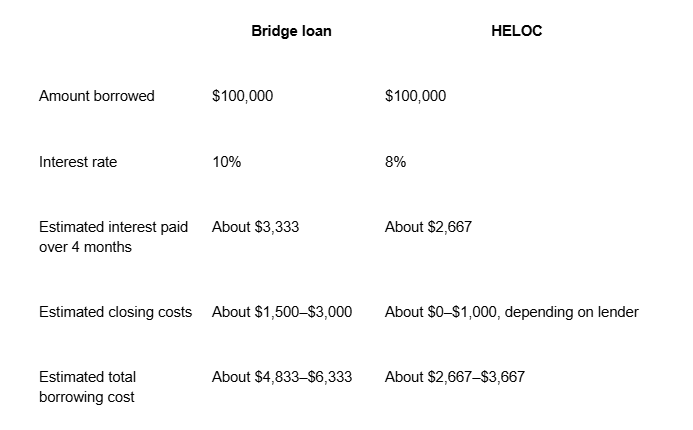
In this example, the HELOC is estimated to cost less because it has a lower interest rate and typically involves fewer upfront fees. However, cost is only one factor to consider. A HELOC requires enough equity and lender approval, and it usually needs to be opened before you list your home. A bridge loan may make more sense for homeowners who need financing quickly after finding a new home, especially if they don't already have a HELOC in place.
Can you use a bridge loan or HELOC for a down payment?
In many cases, yes. Both bridge loans and HELOCs can be used to help fund the down payment on your next home, provided your mortgage lender allows it and you meet the lender's qualification requirements.
If part or all of the down payment comes from borrowed funds, your mortgage lender will typically ask you to document the source of the money. They'll also consider how taking on that additional debt affects your ability to qualify for a new mortgage.
How a bridge loan or HELOC can affect mortgage approval
Using a bridge loan or HELOC doesn’t automatically prevent you from qualifying for a mortgage. However, because both add debt to your financial picture, lenders will consider whether you can manage the additional obligation along with your new mortgage. This may affect your debt-to-income (DTI) ratio and, in some cases, how much you’re able to borrow for your mortgage.
With a bridge loan, lenders typically review the loan terms, including how and when the loan will be repaid. Because bridge loans are usually intended to be paid off with the proceeds from selling your current home, lenders want to understand your repayment plan and whether the expected sale supports it.
With a HELOC, lenders generally focus on the required monthly payment when calculating your DTI ratio. During the draw period, that payment may consist of interest only, but it still counts as a monthly debt obligation when lenders evaluate your application.
If you’re considering either option, talk with your mortgage lender early in the process. Understanding how they evaluate additional debt can help you avoid surprises when you’re ready to buy your next home.
Bridge loan vs. HELOC: Which is right for you?
The right choice depends on your timeline, financial situation, and how you plan to use your home equity. Bridge loans are designed for time-sensitive home purchases, while HELOCs may offer more flexibility and lower borrowing costs for homeowners who can plan ahead.
A bridge loan may be a better fit if:
- You've already found your next home and need funds before selling your current one.
- You need a large amount of money upfront for a down payment, closing costs, or the purchase of your next home.
- You expect to sell your current home soon and repay the loan with the proceeds.
- You want financing designed specifically for the transition between buying and selling homes.
A HELOC may be a better fit if:
- You're planning ahead and want access to your home's equity before you need it.
- You want the flexibility to borrow only what you need rather than receive a lump sum.
- You aren't sure how much you'll need for your next home purchase or other expenses.
- You have enough equity and income to qualify and manage the additional monthly payment.
Alternatives if neither option is the right fit
A bridge loan or HELOC can help homeowners buy before selling, but they aren't the right fit for everyone. Some homeowners may not qualify, may prefer to avoid taking on additional debt, or may not want the risk of managing multiple housing payments while waiting for their current home to sell. If that sounds like your situation, there may be other options to consider.
Home sale contingency
A home sale contingency is a clause in a purchase agreement that makes buying a new home dependent on selling your current home first. This can reduce the financial risk of owning two homes at once, but in a competitive market, some sellers may be less likely to accept a contingent offer.
Cash-out refinance
A cash-out refinance replaces your existing mortgage with a larger loan and allows you to receive the difference in cash. While this can provide funds for a down payment, it may not be ideal if you want to avoid refinancing your current mortgage or taking on a potentially higher interest rate.
Personal savings
Using your own savings avoids taking on additional debt and may simplify the mortgage approval process. However, this option is only practical if you have enough available cash outside of the equity in your current home.
Buy-before-you-sell programs
Some programs are designed to help homeowners buy their next home before selling their current one, reducing the need to time the purchase and sale to close at the same time. These programs may provide different ways to access home equity or manage the transition between homes.
How Flyhomes can help you buy before you sell
If you're considering a buy-before-you-sell program as an alternative to a bridge loan or HELOC, Flyhomes offers solutions that take a different approach. Unlike traditional financing options, which are generally underwritten based on your current financial picture, Flyhomes may consider the expected sale of your current home as part of the transaction. In some cases, that may give eligible homeowners more flexibility when qualifying for their next purchase.
Flyhomes' Buy Before You Sell solutions are designed to support the entire transition between homes, not just provide short-term financing. Depending on the program and your qualifications, you may be able to:
- Unlock equity before selling your current home
- Avoid a home sale contingency when making an offer
- Reduce the impact of your current mortgage on debt-to-income (DTI) calculations
- Purchase your next home before selling their current one
- Make a stronger, cash-equivalent offer in competitive markets
If you're looking for an alternative to a traditional bridge loan or HELOC, explore Flyhomes' Buy Before You Sell programs to find the right solution for your next move.
FAQs
Do I need to sell my current home before applying for a bridge loan or HELOC?

No. A bridge loan is typically obtained after you've found your next home but before your current home sells. You usually need to open a HELOC before you list your current home, because many lenders won't approve a new line of credit on a home that's already for sale.
How quickly can I close on a bridge loan compared with a HELOC?
Bridge loans may close faster than HELOCs because they're designed to help homeowners complete a time-sensitive home purchase. While timelines vary by lender, bridge loans often close in about one to two weeks, while a HELOC may take two to six weeks or longer, especially if a home appraisal is required. Ask each lender for its estimated funding timeline before relying on either option for a purchase deadline.
Can I use a bridge loan or HELOC for closing costs and earnest money?
Yes. Depending on the lender and loan terms, bridge loan or HELOC funds can often be used for expenses such as a down payment, closing costs, and earnest money. Confirm with your lender which uses are permitted before borrowing.
What happens if my home doesn't sell before the bridge loan comes due?
If your home doesn't sell before the bridge loan term ends, you may need to request an extension, refinance the loan, or find another way to repay the balance. The options available depend on your lender and loan terms. A HELOC typically offers more flexibility because there is no set home-sale deadline, but because HELOC rates are typically variable, your borrowing costs could increase if rates rise while you still have an outstanding balance.
Can a lender freeze or reduce a HELOC after it has been opened?
Yes. This may happen if there are significant changes to your financial situation, your home's value, or other factors that increase the lender's risk. Review your HELOC agreement to understand when access to your available credit may be limited.

Close in 10 days like a cash buyer and move only once
Close in 10 days like a cash buyer and move only once
Read More