
Michael Markowitz
%20(1).avif)
You already own a home, but now you're thinking about buying another one. Maybe your family needs more space, or you're considering keeping your current property as a rental. Before you start house hunting, you may be wondering: Can you actually buy another home while you still have a mortgage? And if you can, is keeping or selling your current home the better move?
This guide walks you through your options for buying a house while owning another, from how lenders evaluate your existing mortgage to ways you can use your home's equity to help fund the purchase.
Can you buy another house if you already own one?
Yes, you can buy another house while you still own your current home. The bigger question may be whether you can qualify for financing to purchase another property while continuing to pay for your current one.
Lenders look at your overall financial picture when you apply for another mortgage, including your income, credit, down payment, cash reserves, and existing debts. Your debt-to-income ratio (DTI) is especially important because it compares your monthly debt payments with your gross monthly income.
If you're still paying a mortgage on your current home, that payment generally factors into your DTI along with the proposed mortgage on your new home. That doesn’t necessarily mean you can’t qualify. Whether you’re able to move forward may depend largely on how your existing mortgage fits into your finances and whether you plan to keep your current home or sell it.
Decide first: Are you keeping your current home or selling it?
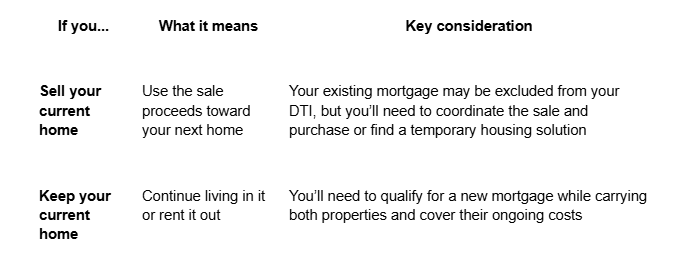
What you plan to do with your current home can shape the way you approach buying another one. Keeping it means taking on the costs of another property, while selling it means coordinating that sale with the purchase of your next home.
If you’re keeping your current home
Your finances will need to support two properties. In addition to the mortgage on your new home, you’ll still have your current home's mortgage, property taxes, insurance, maintenance, and other costs. If you convert the property to a rental, that income may help you qualify for the new mortgage, although lenders may not count all of the expected rent.
If you’re selling your current home
Equity from the sale can help fund your next purchase, but you'll need to coordinate the two transactions. Selling first gives you access to the sale proceeds but may require temporary housing if you haven't found your next home. Buying first lets you move directly into your next home but may require financing while your current home is still on the market.
TIP: You can also make your offer contingent on selling your current home, which can give you time to complete the sale before purchasing your next property. However, sellers may prefer offers without a home-sale contingency, especially in a competitive market. If you expect competition, plan for a financing option that would allow you to make a non-contingent offer.
How lenders evaluate you when you already have a mortgage
Of everything lenders review, your DTI is where an existing mortgage matters most. Your current payment, your other debts, and the proposed payment on the new home all count toward the ratio.
For example, suppose you earn $10,000 a month before taxes and have a $2,500 mortgage payment on your current home, plus $500 in other monthly debt payments. Your total monthly debt is $3,000:
$2,500 current mortgage + $500 other debt = $3,000
$3,000 ÷ $10,000 = 30% DTI
A 30% debt-to-income ratio may fall within the limits for many mortgage programs, although the maximum varies by loan type, lender, and your overall financial profile.
Now suppose you're considering another home with a proposed mortgage payment of $3,000 a month. Adding that payment would bring your total monthly debt to $6,000:
$2,500 current mortgage + $500 other debt + $3,000 new mortgage = $6,000
$6,000 ÷ $10,000 = 60% DTI
A 60% DTI is above the maximum allowed by many mortgage programs. In this example, the existing $2,500 mortgage has already used part of the DTI available to support the new loan. Even if you can comfortably afford the new $3,000 payment on its own, the lender has to consider both mortgages when determining whether you qualify.
When your existing mortgage may be treated differently
Your current mortgage may not always be treated the same way. What you plan to do with your current home can affect how the lender accounts for its mortgage payment.
For example, if you're selling your current home, a lender may be able to exclude that home's mortgage payment from your DTI once the sale meets the loan's requirements, such as having an executed sales contract. The exact requirements vary, so you'll need to confirm them with your lender.
Using the earlier example, excluding the $2,500 payment leaves $500 in other debt plus the $3,000 new mortgage:
$500 other debt + $3,000 new mortgage = $3,500
$3,500 ÷ $10,000 = 35% DTI
That drops the ratio from 60% back to a level that may fall within the limits for many mortgage programs.
If you're planning to rent out your current home, the rental income it generates may help you qualify for the new mortgage by offsetting some of the property's housing costs. Lenders typically require documentation of the rental income and may count only a portion of the expected rent when evaluating your application.
Your current mortgage is only one part of the lender's assessment. When you apply for another mortgage while still owning your current home, lenders may also consider:
- Credit: Your credit score and history.
- Income: Your income and whether it is stable and documentable.
- Down payment: How much you're putting toward the new home.
- Cash reserves: How much money you'll have available after the purchase.
- Existing debts: Other recurring debts, such as car loans, student loans, and credit cards.
- Property type and occupancy: Whether the new home will be your primary residence, a second home, or an investment property.
If you're keeping your current home: Rent it out or keep it as a second home
If you’re shopping for a new home, you generally have two options regarding your current home: continue living there as one of your residences or convert it to a rental property. The choice can affect the type of financing you need and how a lender evaluates your application for another mortgage.
Keep your current home as a second home
If you decide to keep your current home for your own use rather than rent it out, you’ll need to be prepared to cover its costs while also paying for your new home. That includes the existing mortgage, property taxes, insurance, maintenance, and other ongoing expenses.
If the property qualifies as a second home under the applicable loan requirements, financing rules may differ from those for an investment property. Second-home mortgages generally require you to occupy the property for at least part of the year, while investment-property mortgages are intended for properties you don't occupy yourself.
Rent out your current home
Renting out your current home can let you keep the property while generating income to help cover its ongoing costs. That rental income may also help you qualify for your new mortgage, depending on the loan program and how the lender calculates qualifying income.
But qualifying for the new mortgage is only part of the decision. Turning your current home into a rental also means taking on the responsibilities of being a landlord. You’ll need to handle finding and screening tenants, collecting rent, and responding to maintenance issues, or hire a property manager to take on some of those responsibilities for a fee.
You’ll also want to check whether your current mortgage and homeowners insurance allow you to convert the property from a primary residence to a rental, and whether you’ll need different insurance coverage. Local landlord-tenant laws and tax rules may also apply.
The costs of owning both homes, whether you live in the current one or rent it out, are worth considering before you decide which approach makes sense for you.
The real costs of carrying two homes, even temporarily
Even if you plan to sell your current home or eventually rent it out, there may be a period when you’re responsible for two properties. The costs can add up quickly, so consider what you may be paying during the transition:
- Two mortgage payments: If you buy before your current home sells, you may need to make both mortgage payments until the sale closes.
- Taxes and insurance: You’ll generally have property taxes and homeowners insurance on both properties while you own them.
- Utilities and maintenance: An unoccupied home may still require utilities, upkeep, and repairs.
- Selling costs: If you’re selling your current home, factor in the costs of preparing it for sale and completing the transaction.
- Moving and temporary housing: Depending on the timing of your sale and purchase, you may need storage, temporary housing, or more than one move.
- Rental-property costs: If you’re keeping your current home as a rental, account for vacancies, repairs, property management, and other costs of operating the property.
These expenses don't necessarily make buying another home impractical. But understanding your total carrying costs can help you decide how much overlap you’re comfortable with and how much financial cushion you’ll need.
How to buy your next home before your current one sells
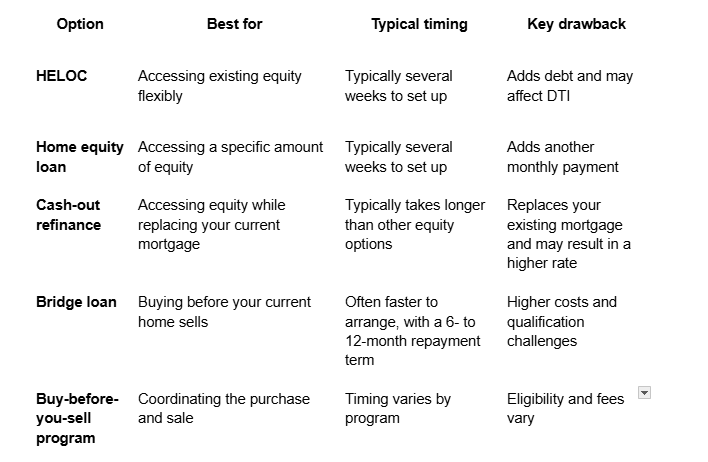
If you decide to buy your next home before your current one sells, you'll need both a way to fund the purchase and a way to qualify for a mortgage while you still own your current home. Depending on your available equity, financial situation, and timeline, you may have several options for making the transition work.
- HELOC: Borrow against your current home's equity and draw funds as needed, potentially giving you access to money before the home sells.
- Home equity loan: Borrow a specific amount against your current home's equity, typically receiving the funds as a lump sum.
- Cash-out refinance: Replace your existing mortgage with a larger one and receive part of your equity as cash.
- Bridge loan: Use short-term financing to help purchase your next home while your current home is still for sale.
- Buy-before-you-sell program: Use a program designed to help you purchase your next home before selling your current one, often by helping you access the equity in your current home before the sale.
Here's how the options compare:
Mistakes to avoid when buying while you still own your current home
Buying another home while you still own your current one can give you more flexibility, but it also creates opportunities for costly miscalculations. Keep these common mistakes in mind:
- Assuming you have to sell first: Selling your current home before buying another is one option, but depending on your finances and the loan program, you may be able to buy your next home while keeping your current one.
- Overlooking how your current mortgage affects qualification: Even if you can comfortably afford the new mortgage payment on its own, you may not qualify for the loan if your existing mortgage and other debts push your DTI too high.
- Expecting rental income to completely cover the mortgage: Rent may help cover your current home's costs, but you'll still need to account for vacancies, repairs, maintenance, and other expenses.
- Underestimating the cost of carrying two homes: If you keep your current home, you'll need to cover its mortgage, taxes, insurance, utilities, and maintenance alongside the costs of your new home. If you rent it out, you'll also need to account for vacancies, repairs, property management, and other rental expenses.
- Overlooking the timing of the sale and purchase: If you plan to sell your current home, the timing of the two transactions can affect how you finance the transition, where you'll live between homes, and how much cash you'll need along the way.
- Assuming all of your home equity is immediately available: Normally, you can turn the equity in your current home into cash by selling the property and using the proceeds toward your next purchase. But if you want to buy your next home before the sale, you may need those funds sooner. In that case, you may need additional financing or a buy-before-you-sell solution to access that equity before the sale.
FAQs
How do you sell a house while buying another at the same time?

You can buy and sell homes at the same time by coordinating the two transactions, using temporary financing, or using a buy-before-you-sell solution. The best approach depends on your timing, available funds and equity, and whether you need the proceeds from your current home to fund the next purchase.
Does your current mortgage count against your debt-to-income ratio for a new loan?
Your current mortgage generally counts toward your debt-to-income ratio (DTI) when you apply for a new mortgage. However, a lender may be able to exclude the existing mortgage if you’re selling the home and meet the loan program’s requirements. If you’re keeping the property as a rental, qualifying rental income may offset some of the mortgage payment when the lender evaluates your application.
What happens if your first house doesn’t sell after you buy the new one?
If your current home doesn’t sell after you buy your new home, you may need to carry both mortgages and the other costs of owning two properties. Depending on your finances and plans for the property, you may continue marketing the home, rent it out, or use short-term financing or a buy-before-you-sell solution to manage the transition until the home sells.
Can you rent out your current home and count that income toward qualifying?
Yes, qualifying rental income from your current home may be used to help you qualify for a new mortgage. Lenders generally require documentation of the rental income and may count only a portion of the expected rent under their underwriting guidelines.
Is it better to sell first or buy first?
Neither buying nor selling first is universally better; the right choice depends on your finances, timeline, housing needs, and ability to qualify while owning two homes. Selling first can provide funds for the next purchase and reduce the risk of carrying two properties, but it may mean temporary housing or even moving twice. Buying first can give you more control over your move but may require additional financing or other planning.
Have more questions? Visit the Flyhomes FAQ for more information about buying and selling a home.

Buy Before You Sell Email Templates - Buyer Facing
Ready-to-use email templates to help you easily introduce Flyhomes Buy Before You Sell solutions to your buyer clients.
Read More
Close in 10 days like a cash buyer and move only once
Close in 10 days like a cash buyer and move only once
Read More.jpg)