
Michael Markowitz

Buying a new home is stressful. So is selling your current one. Trying to buy and sell at the same time can quickly turn into a complicated juggling act.
Ideally, homeowners would be able to move seamlessly from one home to the next without worrying about delays, temporary housing, overlapping mortgages, or rushed decisions. But in reality, buying and selling at the same time often involves difficult trade-offs between convenience, financial flexibility, and timing.
The good news is there are several ways to approach the process. The right strategy depends on your budget, timing, local market conditions, and how much risk you’re willing to take, especially if you’re relocating, upsizing, or downsizing for retirement.
In this guide, we’ll break down the biggest challenges homeowners face, the most common ways people navigate the process, and what to consider when deciding which approach makes the most sense for your situation.
Why buying and selling a house at the same time is so difficult
Buying and selling a house all at once can feel like trying to solve a puzzle while all the pieces keep moving. Instead of managing one real estate transaction, you’re coordinating two interconnected deals with multiple parties, complex financing structures, and separate timelines. Adding to the chaos, you may need to figure out where you’re going to live during the transition.
The challenge usually comes down to three major pressure points: Timing, finances, and moving logistics. And even when you solve one problem, it can often create another.
Timing pressure
Real estate transactions involve a lot of people, all working on their own schedules. Buyers, sellers, lenders, agents, inspectors, appraisers, and title companies all need to stay aligned throughout the process.
Even small delays can create ripple effects. If your buyer’s financing gets pushed back a few days, for example, the sale of your current home could be delayed. This may also postpone the purchase of your next home if you’re relying on those proceeds for your down payment. In competitive markets, where sellers often expect fast closings and clean offers, staying on schedule becomes even more critical.
Financial pressure
For many homeowners, the equity tied up in their current home helps fund the purchase of the next one. Some buyers need sale proceeds for a down payment.Others must qualify for a new mortgage while still temporarily carrying their existing one.
Between down payments, mortgage approval, and overlapping housing costs, buying and selling a house at the same time can quickly become financially complicated.
Moving pressure
There’s also the practical side of the move itself.
Depending on how the timelines unfold, you may need temporary housing between homes, short-term storage for your belongings, or even two separate moves. Coordinating move-out and move-in dates can become especially stressful if the sale of your current home closes before your new home is ready.
The 3 traditional ways to buy and sell a house at the same time
Most homeowners who are buying and selling a home at the same time manage the process in one of three ways: selling before buying, buying before selling, or trying to close both deals at nearly the same time. Each approach can help reduce one type of stress while increasing another.
Option 1: Sell your current home before buying
The safer but less convenient approach
In this scenario, you typically sell your current home first, access the proceeds from your home equity, and then begin shopping for your next property. For many homeowners, this is the most financially straightforward option.
Selling first can make it easier to qualify for a new mortgage because you’re no longer carrying your previous home loan. It also gives you a clearer understanding of your budget since you already know how much equity you’re walking away with from the sale.
The main drawback is the transition between properties. If you don’t find your next place quickly, you may end up moving twice: Once into temporary housing and again into your next home.
In some cases, you may be able to negotiate a rent-back agreement that allows you to stay in your home for a short period after closing. But those arrangements aren’t always available or long enough to fully solve the timing issue. As a result, some homeowners feel pressure to buy quickly after selling, especially in competitive markets where inventory is limited.
Option 2: Buy before selling
The more flexible but financially riskier approach
Some homeowners prefer to buy their next home before selling their current one because it provides more flexibility. You may have more time to search for the right property and avoid making rushed decisions. Once you’ve purchased your next place, you can coordinate a single move instead of juggling temporary housing or storage between properties.
But that convenience often comes with a hefty price tag. When selling and buying a home at the same time, purchasing your new property first may mean temporarily carrying two mortgages, which can complicate financing and increase monthly housing costs.
Some homeowners also need to tap into equity from their current property to help fund the down payment on the next one. To help bridge that gap, buyers often rely on options like HELOCs, bridge loans, home sale contingencies, or buy-before-you-sell programs.
Even with those options, this approach can become stressful if your current property doesn’t sell as quickly as expected. The longer you’re responsible for two properties, the more expensive the situation can become.
Option 3: Concurrent closing
The balancing act
A concurrent closing means the sale of your current home and the purchase of your next one happen on the same day, or within a very tight timeline.
For homeowners trying to avoid temporary housing or carrying two homes at once, this can sound like the ideal solution. In many cases, the proceeds from your home sale are immediately used to help fund the purchase of the next property. If everything goes according to plan, you may be able to move directly from your current home into your next one.
🏠 Current home sale closes → 💰 Equity/funds transferred → 🗝️ New home purchase closes → 📦 Move into new home
Concurrent closings can be efficient when everything falls into place, but the approach leaves very little room for error. Every moving piece has to stay perfectly aligned, which can make the process especially stressful for buyers hoping both transactions stay on schedule. Something as simple as a delayed wire transfer or last-minute lender issue can affect both closings and leave buyers scrambling to adjust moving plans or closing schedules at the last minute.
How to choose the right strategy for your situation
There’s no single approach that works for everyone. The right plan depends on your available equity, timeline flexibility, comfort level with risk, and whether you prioritize convenience or financial certainty.
Here’s a quick look at how the three traditional approaches compare:
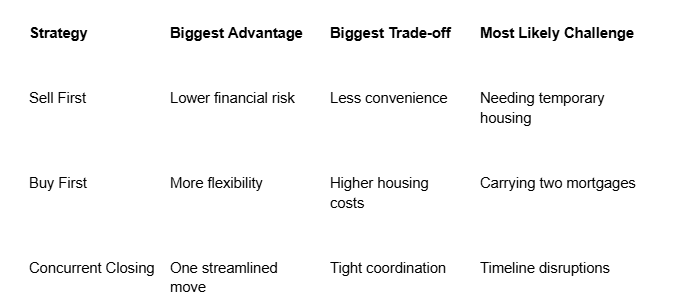
Market conditions can also affect which strategy makes the most sense. In competitive seller’s markets, home sale contingencies may make offers less attractive. In slower markets, buyers may have more flexibility to negotiate timing, rent-back, or sale contingencies.
As a general rule, the right strategy depends on which trade-off you’re most comfortable making:
- Choose selling first if financial certainty matters more than convenience.
- Choose buying first if you can comfortably qualify for and carry two homes temporarily.
- Choose a concurrent closing if your buyer, seller, lender, and title companies can stay tightly coordinated.
For many homeowners, the challenge is that the traditional options all involve a meaningful trade-off: Financial certainty, convenience, or timing control. That’s where buy-before-you-sell programs can help bridge the gap.
These programs can be a helpful middle ground for homeowners who want to reduce timing stress without giving up as much financial certainty. Depending on the solution, these programs may help homeowners avoid a home sale contingency, reduce the likelihood of moving twice, or buy before selling without relying as heavily on perfectly synchronized closings.
How Flyhomes helps reduce timeline stress
One of the biggest challenges of buying and selling a house at the same time is how dependent the entire process can become on a single timeline. Using traditional financing methods, many homeowners need proceeds from their current home to fund the next purchase, which can create pressure to sell quickly, coordinate simultaneous closings, or include a home sale contingency in their offer.
Flyhomes’ Buy Before You Sell solutions are designed to reduce some of that pressure by taking a different approach. Rather than relying only on a borrower’s current financial picture, some Flyhomes solutions factor the expected sale of the current home into the overall transaction. In some cases, that may provide more flexibility than traditional underwriting alone.
Depending on the program and borrower qualifications, eligible homeowners can unlock equity from their current home before selling it, reduce the impact of their current mortgage in debt-to-income calculations, or avoid overlapping monthly payments during the transition period. Some Flyhomes programs can also help buyers make non-contingent or cash-like offers in competitive markets where sellers often prefer fewer conditions attached to the deal.
By reducing the need to perfectly synchronize both transactions, this approach can give homeowners more flexibility to buy first, move once, and sell their previous home afterward. That can mean less pressure to find temporary housing, rush into a purchase decision, or coordinate two closings on the same day.
Looking for a way to buy and sell a home with less timeline pressure? Flyhomes can help you explore options for a more manageable transition.
FAQs
Can you buy and sell a house on the exact same day?
Yes. This is often called a concurrent closing, and it can be appealing because proceeds from the sale are immediately used to help fund the new purchase. It may also help homeowners avoid temporary housing, multiple moves, or carrying two homes at once.
But this approach also requires careful coordination between lenders, title companies, agents, buyers, and sellers. Because both transactions are closely connected, even minor timing issues can affect the entire process.
What is a home sale contingency?
A home sale contingency is a clause in a real estate purchase agreement that makes your offer dependent on selling your current home first.
For buyers, this can provide an important layer of financial protection by helping ensure they’ll have proceeds from the sale available to help fund the new purchase. However, sellers may view these offers as less attractive, especially in competitive markets where they have multiple offers to choose from.
Will sellers accept an offer with a home sale contingency?
Sometimes, but it depends heavily on the market. When inventory is high or buyer demand is lower, sellers are often more open to these types of offers. In more competitive markets, however, contingent offers are typically seen as riskier because the deal depends on the buyer successfully selling their current home first.
What is a rent-back agreement?
A rent-back agreement is an arrangement where the buyer of a home allows the seller to stay in the property for a set period after closing. In this setup, the seller temporarily becomes a tenant and pays rent to the new owner during the agreed-upon timeframe.
For homeowners, rent-backs can be a helpful way to create extra time to find and close on the next home without needing temporary housing or rushing the transition. However, these periods are usually limited and may not fully solve timing challenges if the purchase of the next home takes longer than expected.
How do you use home equity to buy another house?
Homeowners can use the equity in their current home to help fund the purchase of their next one in several ways. Depending on how much equity you’ve built up, you may be able to use proceeds from the sale of your current property, borrow against your home with a HELOC or bridge loan, refinance, or work with a buy-before-you-sell program. The right approach depends on factors like your timeline, financing qualifications, comfort level with debt, and how competitive your local market is.
Do you need the same real estate agent to buy and sell?
No. You can choose to use the same real estate agent for both transactions or work with separate agents for each one.
Many homeowners use the same agent because it can simplify communication and coordination across both timelines. Others prefer separate agents depending on location, property type, or personal preference, especially when buying and selling in different areas.
FAQs
Can you buy and sell a house on the exact same day?

Yes. This is often called a concurrent closing, and it can be appealing because proceeds from the sale are immediately used to help fund the new purchase. It may also help homeowners avoid temporary housing, multiple moves, or carrying two homes at once.
But this approach also requires careful coordination between lenders, title companies, agents, buyers, and sellers. Because both transactions are closely connected, even minor timing issues can affect the entire process.
What is a home sale contingency?
A home sale contingency is a clause in a real estate purchase agreement that makes your offer dependent on selling your current home first.
For buyers, this can provide an important layer of financial protection by helping ensure they’ll have proceeds from the sale available to help fund the new purchase. However, sellers may view these offers as less attractive, especially in competitive markets where they have multiple offers to choose from.
Will sellers accept an offer with a home sale contingency?
Sometimes, but it depends heavily on the market. When inventory is high or buyer demand is lower, sellers are often more open to these types of offers. In more competitive markets, however, contingent offers are typically seen as riskier because the deal depends on the buyer successfully selling their current home first.
What is a rent-back agreement?
A rent-back agreement is an arrangement where the buyer of a home allows the seller to stay in the property for a set period after closing. In this setup, the seller temporarily becomes a tenant and pays rent to the new owner during the agreed-upon timeframe.
For homeowners, rent-backs can be a helpful way to create extra time to find and close on the next home without needing temporary housing or rushing the transition. However, these periods are usually limited and may not fully solve timing challenges if the purchase of the next home takes longer than expected.
How do you use home equity to buy another house?
Homeowners can use the equity in their current home to help fund the purchase of their next one in several ways. Depending on how much equity you’ve built up, you may be able to use proceeds from the sale of your current property, borrow against your home with a HELOC or bridge loan, refinance, or work with a buy-before-you-sell program. The right approach depends on factors like your timeline, financing qualifications, comfort level with debt, and how competitive your local market is.
Do you need the same real estate agent to buy and sell?
No. You can choose to use the same real estate agent for both transactions or work with separate agents for each one.
Many homeowners use the same agent because it can simplify communication and coordination across both timelines. Others prefer separate agents depending on location, property type, or personal preference, especially when buying and selling in different areas.

Buy Before You Sell Email Templates - Buyer Facing
Ready-to-use email templates to help you easily introduce Flyhomes Buy Before You Sell solutions to your buyer clients.
Read More
Close in 10 days like a cash buyer and move only once
Close in 10 days like a cash buyer and move only once
Read More.jpg)